

Winch Control Options:
Wired vs Wireless
When it comes to operating your winch safely and efficiently, winch control is a key factor to consider. Traditionally, winches have been controlled using basic wired solutions. However, modern technology has introduced advanced wireless alternatives. This article explores both options—highlighting their advantages and limitations—so you can choose the best control method for your application.
Traditional Winch Controls – Wired Solutions
Historically, winch control has been achieved via a two-way rocker switch mounted on your dashboard or a plug-in handheld pendant. The pendant typically connects directly to the winch's control box or to a strategically placed socket on the exterior of your vehicle.
These traditional methods are still widely used and can be found across the RED Winches product range. They provide a simple, hard-wired connection to your winch and are favoured in many standard applications.
Pros:
-
Simple troubleshooting – Easier for most users to fault-find with a physical connection
-
Cost-effective – Often included with the winch at no extra cost
-
Reliable – Ideal in environments where wireless signals may be obstructed or fail
-
Direct control – No batteries or signal pairing required
Cons:
-
Limited mobility – You must remain inside or close to the vehicle to operate the winch
-
Installation challenges – Routing cables through your vehicle can be complex and may require specialist help
-
Vehicle modifications – May involve cutting or altering your dashboard or bodywork to fit switches
-
Restricted operation – The driver often must also operate the winch unless using a pendant, which can be unsafe in some recovery scenarios
Modern Winch Controls – Wireless Solutions
Wireless winch controls represent the next step in recovery and utility vehicle evolution. These systems include a wireless receiver (usually a compact control box installed in the vehicle) and a handheld remote transmitter, much like a TV remote.
The receiver is powered by the vehicle’s 12V or 24V system and connects directly to the winch. It can be mounted almost anywhere, provided it’s protected from damage and installed in accordance with manufacturer guidelines.
If specified correctly, a wireless system can even be configured to operate multiple winches or other electrical systems from a single handset.
Pros:
-
Operate from a safe distance – Ideal in hazardous conditions where being near the vehicle is unsafe
-
Shared operation – One person can drive while another controls the winch remotely
-
Multi-system control – One remote can manage several winches, lights, or systems
-
Customisable functions – Offers programmable features such as latching, timed operation, and more
-
Minimal vehicle alteration – Reduces the need to cut or modify the vehicle for switches
-
Simplified integration – Easier to install without extensive wiring work
Cons:
-
Higher cost – More expensive than traditional wired solutions
Trusted Wireless Partner: Lodar
RED Winches proudly supports Lodar, a leader in industrial wireless remote control systems since 1984. Lodar’s high-performance products are trusted across the recovery and utility sectors for their durability, flexibility, and reliability.
Their modular systems can be tailored to meet specific requirements, making them ideal for customers who demand bespoke solutions. Like RED Winches, Lodar is committed to excellence, innovation, and safety.
Quick reference guide for the winch controllers
| Model | Mil-Spec Hand Controller (HC-) | Wireless Controller(RW-WWC) | Lodar System(LODAR-) |
| Wired / Wireless | Wired | Wireless | Both |
| Range | N/A | 30m | 61m |
| IP Rating | IP67 | IP67 | IP65 |
| Battery Type | N/A | 2 x 1.5v AAA | 1 x 9v PP3 |
| Can Be Driven over? | Yes | No | No |
| Floats | No | No | Yes |
| Voltage | 12v / 24v | 12v / 24v | 12v / 24v |
| Hand Controller Body Construction | CNC Machined From Delrin | Injection Moulded | Injection Moulded |
| Receiver Construction | N/A | Injection Moulded | Injection Moulded |
How do I pair a wireless winch remote?
For the RW-WWC, see the product page here
For the LODAR, the link to the pairing instructions is available on the Lodar website.
Are wireless winch controllers safe for recovery?
Yes, in particular, LODAR units are now standard across the professional recovery field, thanks to their high-quality build, exceptional reliability, and flexibility in multiple functions, with the ability to program functions for both latching and non-latching control.
Can I use a 24V wireless remote on a 12V winch?
Yes, both the LODAR and the RW-WWC will work on 12v and 24v. They are not voltage-specific. However, the signal voltage required to activate the winch functions is voltage-specific. If you have a 12v motor control solenoid that you will need to use 12v a 12v supply to the receiver. Likewise, if you have a 24v motor control solenoid, you will need to use a 24v supply to the receiver.
Explore Your Options
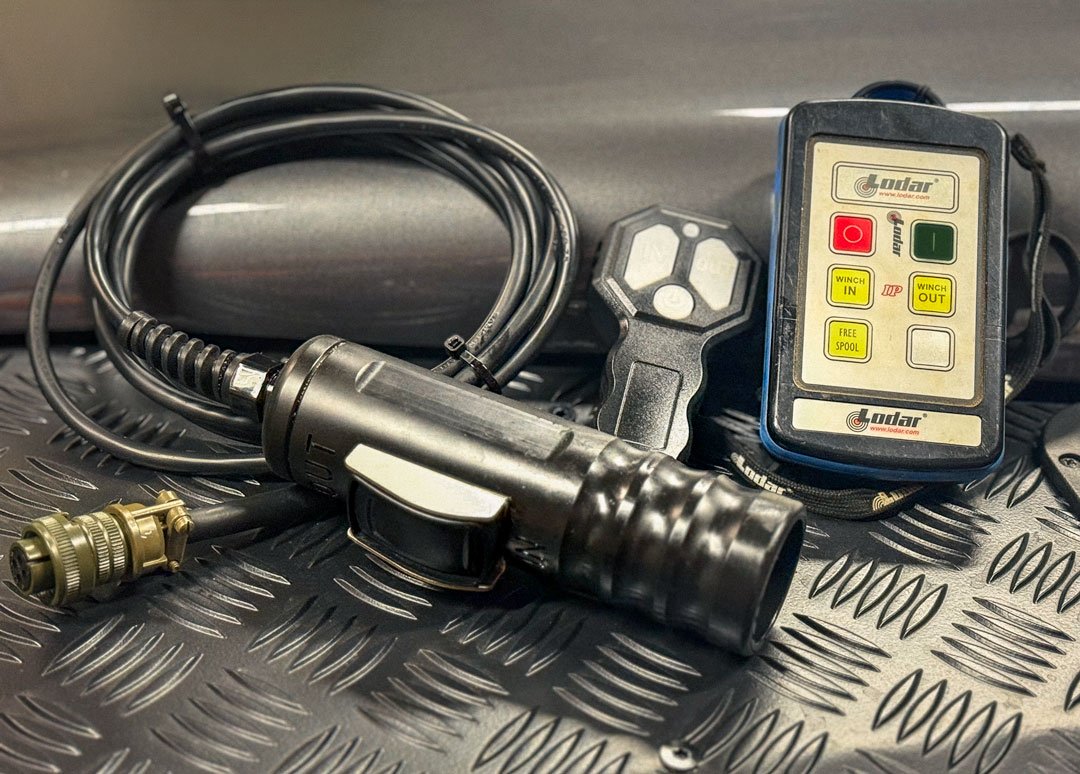
Whether you’re looking for a traditional wired solution or a cutting-edge wireless system, RED Winches has a winch control option to suit your needs. We offer a range of high-quality, field-tested products designed for performance and safety.